Every parent wants to set their child up for financial success. Finding the right savings strategy is a big part of that journey. Starting July 2026, the new Trump Accounts will offer another way for families to support a child's long-term financial growth.
With their specific features and government support, Trump Accounts can help families invest early and let compounding do the work over time. In this guide, we will break down how these accounts work, including eligibility requirements, the $1,000 pilot program, contribution limits, strict investment rules, and how Trump Accounts compare to established options like 529 plans and UTMAs.
What Exactly is a Trump Account?
A Trump Account is a custodial savings vehicle established under the OBBBA legislation. Structurally, it functions similarly to a traditional IRA owned by the child. However, because minors cannot legally manage financial contracts, a parent or guardian manages the account until the child turns 18.
The accounts have been designed around a specific “growth period.” They’re intended to strengthen long-term compounding by limiting access to funds and mandating specific, low-risk investment strategies. Unlike a standard savings account that might lose value to inflation, a Trump Account is designed as a low-risk option to practice saving and investing in the stock market.
Eligibility: Who Qualifies?
Determining if your child qualifies is fairly simple, but there are two tiers of eligibility to understand: general eligibility and the specific pilot program.
General Eligibility
Any child under 18 with a valid Social Security number (SSN) is eligible to have a Trump Account opened on their behalf. This means even if your child is currently 10 or 15 years old, you can still open an account for them to take advantage of the tax-deferred growth structure.
The Pilot Program
The most attention-grabbing feature of the OBBBA is the federal contribution. However, this “seed money” is limited to a specific group and an election to receive this contribution must be made by an authorized individual. To receive the $1,000 federal deposit, the child must be:
-
-
Born between January 1, 2025, and December 31, 2028.
-
A U.S. citizen.
-
If your child falls outside this birth window, you can still open an account and contribute your own funds, but the government will not provide the initial $1,000 deposit.
How to Open a Trump Account
If you’re ready to move forward, mark your calendar for July 5, 2026. This is the official launch date, with first contributions allowed as early as July 4, 2026. While a Trump Account is open to children under 18, enrollment is not automatic. A parent or guardian must elect to join the program.
Currently, the legislation specifies two primary methods to open an account:
1. IRS Form 4547: File this specific form with the IRS to officially elect the account status. It is recommended to file with your 2025 tax return to ensure eligibility during the initial enrollment period.
2. Online Portal: The government is launching trumpaccounts.gov to facilitate a streamlined digital election process.
Initially, the U.S. Treasury will manage the setup of these accounts. Eventually, administration will likely transition to approved private financial institutions, similar to how HSAs or IRAs are managed today.
Pro Tip: Monitor trumpaccounts.gov for updates, additional guidance, and any changes to enrollment or administration.
Contribution Limits & Rules
Trump Accounts are designed to be helpful savings tools, but they do come with caps and are structured to help prevent abuse.
Annual Cap
Total contributions are limited to $5,000 per child, per year (indexed for inflation). This cap generally applies to most combined sources, excluding the government seed amount and qualified general contributions (i.e., charitable contributions).
Funding Sources
One of the most attractive aspects of Trump Accounts for kids is the flexibility around contribution types.
-
Government seed: The pilot program’s $1,000 contribution does not count toward the annual limit. These funds are generally taxable upon withdrawal.
-
Individuals: Parents, grandparents, aunts, uncles, or family friends may contribute. Unlike a custodial Roth IRA, contributions are not tied to earned income. Individual contributions are on an after-tax basis, so contribution funds are generally not taxed upon withdrawal.
-
Charities: 501(c)(3) organizations are permitted to contribute. These charitable contributions do not count toward the $5,000 annual limit, offering an additional way for foundations and community organizations to support children’s futures.
-
Employers’ Contributions & Employee Deferrals: A child’s account can be funded by employer contributions and/or employee pre-tax payroll deductions. These contributions are taxed when funds are withdrawn.
-
-
-
Employers may contribute or match up to $2,500 (indexed for inflation), which counts toward the annual limit.
-
Employees may be able to redirect a portion of pre-tax income to a Trump Account through employee benefit programs.
-
-
-
Example (Employer/Employee Contribution):
If John has two kids and his employer contributes $1,250 to each child’s account, for a total of $2,500, John is eligible to contribute up to $3,750 per child’s account to reach the total $5,000 annual limit.
Tax Treatment
Before contributing, it’s important to understand how Trump Accounts are taxed, especially since funding sources are treated differently.
Currently, the legislation specifies two primary methods to open an account:
Individual Contributions: These are made on an after-tax basis. The money grows tax-free, and generally, withdrawals of contribution amounts are not taxable.
-
Employer Contributions: These are made on a pre-tax basis, similar to a 401(k); withdrawals are typically taxed.
-
Government Seed: The initial $1,000 contribution does not count toward the annual limit, but it is taxable upon withdrawal.
-
General Funding Contributions: State/local government entities and 501(c)(3) organizations may contribute funds. These contributions do not count toward the annual limit, but withdrawals are taxable.
-
Earnings: Regardless of the contribution source, investment earnings are taxable upon withdrawal, subject to applicable rules.
Initially, the U.S. Treasury will manage the setup of these accounts. Eventually, administration will likely transition to approved private financial institutions, similar to how HSAs or IRAs are managed today.
Pro Tip: Keep accurate contribution records. Because funding sources have different tax treatment, proper documentation helps ensure you (or your child later) report withdrawals accurately and avoid over- or underpaying taxes.
Investment & Withdrawal Restrictions
Trump Accounts include strict rules and regulations to help protect funds and support growth over time.
Investment Guardrails
Funds must be invested in low-cost index mutual funds or Exchange Traded Funds (ETFs). Additional requirements include:
Expense Ratio Cap: 0.10% (10 basis points) or less.
U.S. Equity Focus: Investments must be primarily in U.S. companies (similar to an S&P 500 profile).
No Leverage: Borrowing against the account or using margin is strictly prohibited.
In short, Trump Accounts are designed to provide long-term, broad-market exposure with limited risk and complexity.
In short, Trump Accounts are designed to provide long-term, broad-market exposure with limited risk and complexity.
The “Lock-Up” Period
Generally, withdrawals are not permitted before the child turns 18 except for limited rollovers.
After age 18, the account transitions to standard traditional IRA rules. This means the money is still intended for retirement. If the account owner withdraws funds before age 59.5 for a non-qualified reason, they may owe income taxes plus a 10% penalty.
However, standard IRA exceptions would apply, such as:
-
Qualified higher education expenses
-
First-time home purchase (up to $10,000)
-
Birth/adoption costs (up to $5,000)
-
Certain qualifying medical expenses
-
Disability or terminal illness
Additional Options After Age 18
After turning 18, the account owner may also be able to roll the balance into a traditional IRA or another eligible retirement account. This conversion is not automatic and may require additional steps to rollover or convert. Depending on the child’s future tax situation, a Roth conversion may be worth considering.
Trump Accounts vs. Other Child Savings Vehicles
Wondering how these new tax-advantaged accounts compare with existing options like 529 plans or UTMAs? Here is a quick comparison to help you decide.
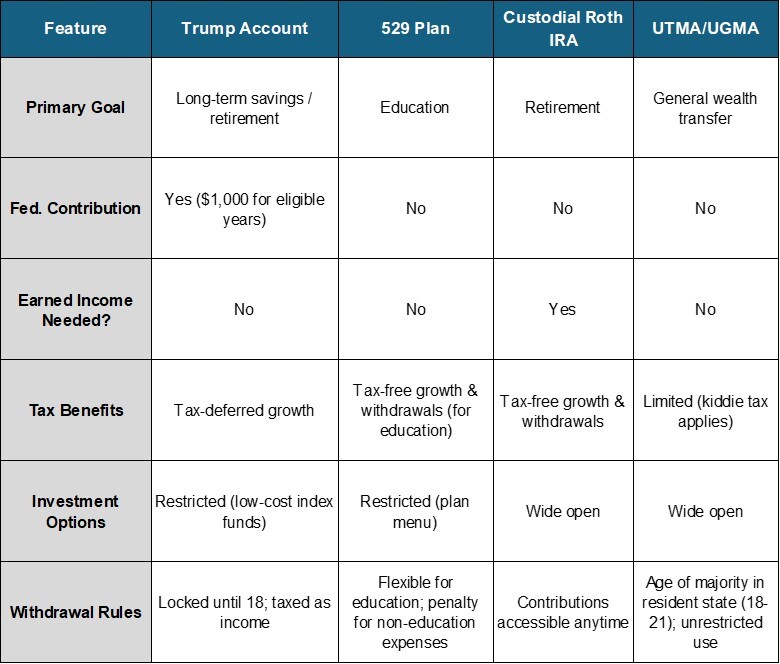
Key Takeaways vs. Competitors
529 Plans: If your primary goal is college savings, a 529 is likely the better option because qualified education withdrawals are tax-free. Trump Account withdrawals are generally taxable.
Custodial Roth IRA: A Roth IRA can offer tax-free withdrawals, but it requires the child to have earned income to make contributions. Trump Accounts may be easier to fund for children without income.
UTMA/UGMA: UTMAs offer more investment freedom but weigh heavily against a student’s financial aid eligibility. Trump Accounts are similar to retirement assets, which may be treated more favorably for financial aid purposes.
Benefits vs. Considerations
Before you file Form 4547, consider the trade-offs for your goals and timeline.
Pros
-
Free Seed Money: For eligible children, the $1,000 government deposit provides an immediate head start on investing.
-
No Earned Income Rule: You can begin contributing for a child’s future without them having a job.
-
Cost Protection: The mandate to keep fees below 0.10% helps protect investors from predatory financial products.
-
Tax-Deferred Compounding: Assets have the potential to grow with less tax drag for 18+ years.
Cons
Strict Lock-Up: Withdrawals are not allowed before age 18. For instance, you can’t borrow against the account for near-term needs like private school tuition, braces, or unplanned expenses.
Taxable Withdrawals: Unlike distributions from a Roth IRA or a 529 plan, distributions from a Trump Account are generally taxed.
Investment Limits: You cannot choose specific stocks or sectors; you’re generally tied to U.S. index strategies.
The Bottom Line
The Trump Accounts are designed as a low-friction way to jumpstart savings for a child. They are particularly compelling for parents of children born between 2025 and 2028 who qualify for the $1,000 pilot contribution. While a Trump Account may not replace a 529 plan for college savings, it can serve as an additional tool for long-term wealth building.
Preparation begins now. Although the official opening date isn’t until July 2026, understanding the OBBBA rules today can help you act quickly once enrollment opens.
Ready to plan your child's financial future? Consult an LTax team member to see how a Trump Account fits into your specific tax, estate, and family planning goals.
LEGAL OR TAX: The information herein is not legal, such as trust or estate planning, advice, or tax advice. Any such information is provided for illustrative purposes only and must not be relied upon without the benefit of the advice of your lawyer and/or tax professional. Lido specifically disclaims any liability from any reliance on such information. Lido is not a legal service provider or tax professional and does not offer legal or tax advice. Should you desire to obtain tax or legal services or advice, you must enter into your own, independent engagement agreement with a licensed attorney or tax professional.