If you are self-employed, tax season can feel especially painful. When you work for someone else, your employer pays half your Social Security and Medicare taxes. When you work for yourself, you are responsible for both portions. This makes your tax bill feel especially high.
Don’t worry, there are legitimate ways to lower what you owe. The key is using business deductions, strategic tax planning, and clean documentation.
Understanding how the tax code treats different types of expenses and business entities is key to lowering your tax exposure. Some strategies reduce your business profit and can lower self-employment tax directly. Others may still be valuable, but they mainly reduce income tax, not the self-employment tax itself. Knowing the difference can help you make smarter decisions and avoid overestimating the benefit of a strategy.
What Is Self-Employment Tax?
Self-employment tax funds two specific federal programs: Social Security and Medicare. When you work as a W-2 employee, your employer pays half of these taxes, and they deduct the other half from your paycheck.
When you’re self-employed, you’re both the employer and the employee. That means you must cover the entire 15.3% tax rate yourself. This includes 12.4% for Social Security and 2.9% for Medicare. For higher income earners, greater than $200,000 for single filers and $250,000 for married couples filing jointly, an additional 0.9% Additional Medicare Tax applies.
The IRS requires almost anyone who earns net income from self-employment to pay this tax. This group typically includes freelancers, sole proprietors, independent contractors, and gig workers.
Single-member LLC owners often pay self-employment tax on their net business earnings, too. Therefore, claiming business expenses remains the most direct way to lower your tax exposure.
Lowering Income Tax vs Lowering Self-Employment Tax
A common mistake business owners make is assuming that any tax deduction automatically lowers self-employment tax. In reality, the IRS treats self-employment tax and income tax differently.
Strategies That May Reduce Self-Employment Tax
To lower self-employment tax, you need to reduce net business profit by claiming ordinary and necessary deductions on Schedule C. Properly deducted expenses decrease your net earnings, which in turn lowers your self-employment tax. The home office deduction is another valid way to reduce net profit if IRS requirements are met.
Strategies That May Lower Income Tax, but Not Self-Employment Tax
Certain financial moves can be highly beneficial for your overall tax plan, even if they don’t lower your self-employment tax. Contributions to a SEP IRA, SIMPLE IRA, or one-participant 401(k) are great for wealth building. However, these are generally above-the-line adjustments claimed on Schedule 1. They reduce your taxable income for income tax purposes, but they do not reduce the Schedule C profit used to calculate self-employment tax. That said, by lowering income tax, they can offset a significant portion of your total tax liability and improve after-tax cash flow.
Claim Every Legitimate Business Deduction
Track and claim every business expense to reduce self-employment taxes. This helps ensure you pay taxes only on actual profit.
The IRS states that a deductible business expense must be both “ordinary and necessary.” Ordinary means the expense is commonly accepted in your trade or industry. Necessary means the expense is helpful and appropriate for your business. These expenses must directly relate to the business, not personal spending.
Common Deductions
You likely incur numerous deductible expenses during regular operations. Some common categories include:
-
Software and professional subscriptions
-
Professional services, such as legal or accounting fees
-
Advertising and marketing costs
-
Business travel and meals that are allowed by tax law
-
Equipment, office supplies, and mileage or actual vehicle expenses
Classifying expenses correctly lowers Schedule C profit and self-employment tax. See our article on self-employed deductions.
Don’t Overlook the Home Office Deduction If You Qualify
Many business owners avoid the home office deduction because they worry it will trigger an audit. If used correctly and well documented, it is a valid way to reduce business profits.
To qualify, you must use a specific part of your home exclusively and regularly for business. It must be your primary place of business or a place where you regularly meet clients.
You can calculate this deduction using two methods. The simplified method allows you to deduct a set rate of $5 per square foot of home office space, up to 300 square feet. The actual expense method requires calculating the business-use percentage of your home costs on Form 8829.
When This Becomes a Red Flag
The home office deduction becomes a red flag when taxpayers claim personal-use spaces, such as a dining room table or a guest bedroom. If you take this deduction, only deduct accurate, business-use space and keep clean records.
Separate Business & Personal Spending
Most tax problems for self-employed individuals come from poor records. The IRS expects you to keep clear books that show gross income and deductions, using proper systems like accounting software or organized digital files.
Practical Documentation Habits
To keep your records audit-ready, establish strong administrative habits. Open separate bank and credit card accounts for business use only. Store receipts digitally and keep complete mileage logs for any business travel. Monthly bookkeeping reviews ensure expenses are categorized correctly and save you from reconstructing a year’s worth of transactions.
Solid recordkeeping supports deductions, reveals missed write-offs, improves quarterly planning, and makes it easier to assess if your business entity still makes sense.
Do Retirement Contributions Reduce Self-Employment Tax?
Retirement accounts are one of the best planning tools for self-employed taxpayers. It’s important to know which taxes they affect before contributing.
Making contributions to a retirement plan can lower your adjusted gross income, reduce federal and state income taxes, and promote long-term financial security.
Common Retirement Accounts
Self-employed individuals have access to several retirement plans, including:
-
SEP IRA
-
SIMPLE IRA
-
Solo or one-participant 401(k)
Important Caveat
Self-employed individuals generally take retirement deductions on Schedule 1, not Schedule C. That means these deductions do not directly reduce self-employment tax. To optimize your year-end tax strategy, review your retirement options and read more in our small-business tax planning article investing.
How the Self-Employed Health Insurance Deduction Can Help
Health insurance is expensive, especially for entrepreneurs. The tax code offers some relief, but, as with retirement deductions, there are rules.
Eligible taxpayers can often deduct premiums for medical, dental, and long-term care insurance for themselves, their spouses, and dependents. To qualify, neither the self-employed individual nor their spouse can be eligible to participate in an employee-sponsored health plan. This deduction lowers taxable income.
However, this deduction is usually figured separately, so it rarely reduces Schedule C profit or self-employment tax.
When an S Corporation May Help Reduce Self-Employment Taxes
For highly profitable businesses, restructuring as an S corporation can be one of the more effective self-employment tax strategies.
An S corporation allows you to split business income into two categories: W-2 wages and shareholder distributions. You pay payroll taxes, which are equivalent to self-employment taxes, on your wages. The remaining profit taken as a distribution is generally exempt from self-employment and payroll taxes, though it is still subject to income tax.
One Rule You Shouldn’t Ignore
You cannot classify all your income as a distribution to avoid taxes. The IRS requires business owners to pay themselves “reasonable compensation” before taking any non-wage distributions. Failing to comply may result in severe penalties.
It’s Time to Consider an S Corp Election
Forming an S corporation isn’t right for everyone. It comes with additional administrative costs, payroll fees, and stricter compliance requirements. This may make sense if your business generates steady profit, you work in the business, and you can manage added bookkeeping responsibilities.
Considering an S Corp election? Run the numbers before making the switch, and read our guide on how to pay yourself from your LLC to avoid compliance issues.
Red Flags That Undermine Legitimate Tax Strategies
The goal is to lower your self-employment tax without inviting IRS scrutiny. Certain behaviors and overly aggressive tactics can trigger audits.
Avoid these common mistakes:
-
Writing off personal expenses as business expenses.
-
Claiming large or unsubstantiated vehicle, travel, or home office expenses.
-
Maintaining poor or incomplete financial records.
-
Switching to an S Corp but setting the owner’s salary too low.
Red flags are often triggered by weak documentation, inconsistent reporting, poor business-personal separation, or a lack of economic reality. If an expense is legitimately tied to your business and you have the receipts to prove it, you are generally on safe ground.
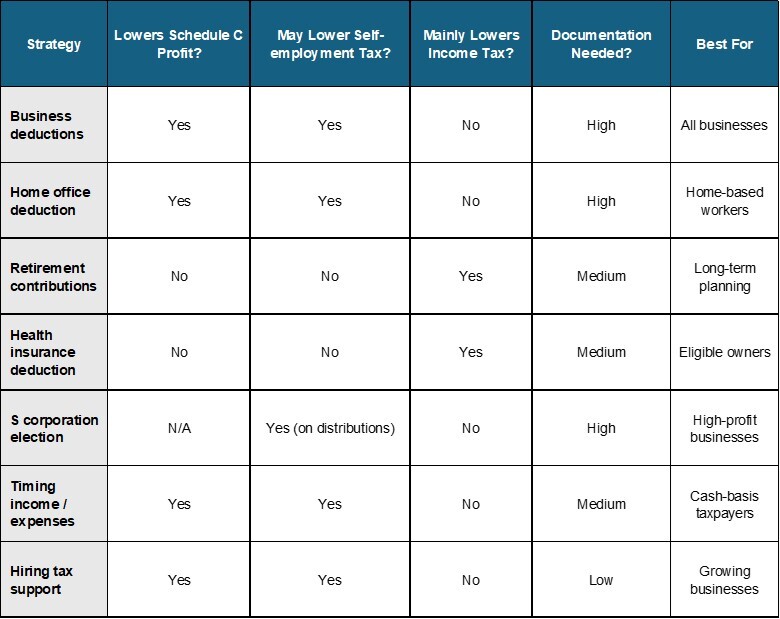
Quick Comparison: Common Self-Employment Tax Moves
Understanding which strategies impact which taxes is necessary for effective planning. Use this as a quick reference.
When to Talk to a Tax Advisor
Self-employed tax planning is complex and requires accuracy. While basic deductions may be straightforward, structural changes involve more risk if handled poorly.
You should consult a professional if you have rising profits, are considering an S Corp election, or are unsure which deductions affect self-employment tax. A tax advisor can also help if you have messy books, mixed personal and business spending, or if you want to plan strategically instead of reacting when filing.
FAQs
How can I legally reduce self-employment taxes?
You can legally reduce self-employment taxes by claiming all ordinary and necessary business deductions, which lowers your net business profit. For higher-earning businesses, an S election may allow you to divide income between a reasonable W-2 salary and owner distributions, which can lower your tax burden.
What deductions reduce self-employment tax?
Any legitimate business expense that reduces your net Schedule C profit can reduce your self-employment tax. This includes software, advertising, legal fees, business mileage, office supplies, and travel expenses.
When does an S Corp help lower self-employment taxes?
An S corporation helps lower self-employment taxes when your business earns enough profit to pay a reasonable W-2 salary while leaving a substantial profit to be taken as distributions. Distributions are not subject to self-employment tax.
Is the home office deduction still a red flag?
The home office deduction is not automatically a red flag if you follow the IRS rules. The space must be used regularly and exclusively for business. accurate measurements and clean records help keep this deduction defensible.
What records should self-employed people keep for deductions?
You should keep receipts, canceled checks, invoices, mileage logs, and separate bank or credit card statements that clearly document the amount, date, and business purpose of each expense.
Secure Your Business Finances
The safest way to reduce self-employment taxes is not by chasing loopholes, but by knowing which strategies truly reduce net self-employment income. You also want to keep in mind which ones mainly reduce income tax and how to record everything properly.
For some businesses, that means tightening up deductions and recordkeeping to make sure no legitimate expenses are missed. For others, it may mean revisiting entity structure and compensation strategy with professional guidance. Either way, making proactive choices can help you keep more of your hard-earned money while staying fully compliant.
Consult an LTax team member today to explore ways to reduce self-employment taxes without creating compliance headaches later.
LEGAL OR TAX: The information herein is not legal, such as trust or estate planning, advice, or tax advice. Any such information is provided for illustrative purposes only and must not be relied upon without the benefit of the advice of your lawyer and/or tax professional. Lido specifically disclaims any liability from any reliance on such information. Lido is not a legal service provider or tax professional and does not offer legal or tax advice. Should you desire to obtain tax or legal services or advice, you must enter into your own, independent engagement agreement with a licensed attorney or tax professional.