Choosing between an LLC and an S Corp can be confusing because the comparison isn't always straightforward. An LLC is a legal business structure formed at the state level. An S Corp is a federal tax election that eligible businesses can choose for tax purposes.
The distinction matters. You are not always choosing between entirely different business structures. In many cases, an LLC can remain an LLC legally while electing to be taxed as an S Corp.
For small business owners, the right choice depends on income, growth stage, payroll readiness, administrative capacity, ownership goals and long-term tax strategy. Here is what to know about S Corp vs. LLC tax treatment, key differences, potential benefits and how to decide which option may fit your business.
In This Article:
What Is an LLC?
An LLC, or limited liability company, is a business structure created under state law. It is popular with small business owners because it can provide liability protection while allowing flexible tax treatment.
An LLC is not a tax classification by itself. For federal tax purposes, the IRS treats an LLC differently depending on the number of owners and any tax elections made.
How LLCs Are Typically Taxed
A single-member LLC is generally treated as a disregarded entity unless it elects corporate taxation. That means business income and expenses are usually reported on the owner’s personal tax return, often using Schedule C. A multi-member LLC is generally treated as a partnership unless it elects to be taxed as a corporation. In that case, the business typically files a partnership return and issues Schedule K-1s to its members.
Why Business Owners Choose an LLC?
NSOs Business owners often choose an LLC because it offers:
-
Relatively simple setup and maintenance.
-
Flexible ownership and management options.
-
Pass-through taxation.
-
Fewer administrative requirements than an S Corp.
A practical structure for sole proprietors, freelancers, consultants, real estate owners and early-stage businesses.
For many new business owners, an LLC is a useful starting point. It can help separate the business from the individual owner without immediately adding the payroll and filing requirements associated with S Corp taxation.
What Is an S Corp?
An S Corp, or S corporation, is not a business entity type in the same way as an LLC is. It is a federal tax election available to eligible corporations and LLCs. This election allows income, deductions, credits and losses to pass through to shareholders for federal tax purposes. In many standard business scenarios, this helps avoid double taxation on corporate income.
An LLC can elect to be taxed as an S Corp if it meets IRS eligibility rules. These rules include limits on the number and types of shareholders, as well as restrictions around ownership and stock classes.
How S Corps Are Typically Taxed?
With S Corp taxation:
-
Owner-employees must be paid a reasonable salary through payroll.
-
This salary is generally subject to payroll taxes.
-
Additional business profit may be distributed to shareholders.
-
Pass-through income is reported on the owner’s personal tax return.
The reasonable salary requirement is important. The IRS requires S corporations to pay reasonable compensation to shareholder-employees for services rendered before making non-wage distributions.
Why Business Owners Choose S Corp Taxation
-
Business owners may choose S Corp taxation because it can:
-
Create potential payroll tax planning opportunities once profit is consistently high enough.
-
Provide a more formal structure for growing businesses.
-
Help separate owner salary from business profit.
-
Support a clearer separation among salary, business profit and distributions.
However, potential savings depend on profitability, reasonable compensation, payroll costs, filing costs, state taxes, bookkeeping and compliance needs.
LLC vs. S Corp: Key Similarities
Before comparing the differences, it’s helpful to know what LLCs and S Corps have in common.
Both can offer pass-through taxation. This means business income generally passes through to the owner’s personal tax return rather than being taxed at the entity level.
Both can also support a stronger separation between the business and the owner. However, this only works well when the owner maintains proper records, uses separate bank accounts, documents expenses and follows applicable business formalities.
Neither structure eliminates the need for tax planning. Business owners still need to think about estimated taxes, bookkeeping, deductible expenses, payroll planning, retirement contributions and year-end tax strategy.
Depending on income, business type, wages and other limitations, eligible pass-through business owners may qualify for the qualified business income (QBI) deduction.
Corp vs LLC: Key Differences Business Owners Should Know
Understanding how LLCs and S Corps differ is critical to making the right choice for your company’s future.
1. Tax Treatment
LLC: Default taxation depends on the number of members. A single-member LLC is usually taxed as a sole proprietorship. A multi-member LLC is usually taxed as a partnership unless another election is made.
S Corp: Offers pass-through taxation but adds payroll requirements for owner-employees.
Example
A freelance designer with a single-member LLC earns $75,000 in net business income after expenses. As a standard LLC, that income is generally reported on the owner’s personal tax return. The owner may also owe self-employment tax on that business income.
If that same designer later elects S Corp taxation and the business grows to $140,000 in net profit, they pay themselves a reasonable salary through payroll. For example, they might take an $80,000 salary and receive some of the remaining profit as shareholder distributions. The exact salary must be reasonable for their role and business.
2. Self-Employment and Payroll Taxes
LLC: LLC owners are typically subject to self-employment tax on all business earnings, depending on how the LLC is taxed and the owner’s role. The self-employment tax is 15.3%, consisting of 12.4% for Social Security and 2.9% for Medicare.
S Corp: Owner-employees must receive reasonable compensation through payroll. That salary is subject to payroll taxes. Remaining profits may be distributed differently for tax purposes, which can create planning opportunities when handled correctly.
This does not mean the S Corp owner avoids taxes on the remaining profit. Salary and distributions are simply treated differently for payroll taxes. The potential savings must be weighed against payroll costs, tax preparation fees, bookkeeping and state-level taxes.
3. Owner Compensation
LLC: Owners typically take owner draws or guaranteed payments, depending on the LLC’s tax status at the federal level. An owner draw is not the same as a paycheck. It is a way for the owner to withdraw money from the business, but it does not automatically cover income tax or self-employment tax obligations.
S Corp: Owner-employees receive W-2 wages and may also receive shareholder distributions. This creates a more formal compensation structure but also adds payroll responsibilities.
Example
An LLC owner may transfer $5,000 per month from the business account to their personal account as an owner draw. An S Corp owner may instead run a set salary through payroll, such as $6,500 per month as taxable W-2 wages, and then take distributions if the business has enough profit.
Learn more about how to pay yourself from your LLC to maintain compliance.
4. Ownership & Management Flexibility
LLC: LLCs generally offer flexible ownership and management structures. The exact rules depend on state law and the company’s operating agreement. An LLC can be member-managed or manager-managed, which gives owners flexibility in day-to-day operations.
S Corp: S Corps are subject to more specific eligibility rules. These include shareholder limits, ownership restrictions and stock restrictions. This can make S Corp status less flexible for businesses with outside investors, complex ownership plans, or certain types of shareholders.
5. Administrative Formalities
LLC: An LLC usually requires fewer formalities. However, strong records still matter. Owners should maintain separate bank accounts, track expenses, document major decisions and keep business and personal finances separate.
S Corp: S Corp taxation generally adds payroll, tax filing, shareholder reporting and compliance requirements. For example, an S Corp owner may need to run payroll, file payroll tax forms, issue a W-2, file Form 1120-S and provide Schedule K-1s to shareholders.
Those added steps are one reason S Corp taxation usually makes more sense once the business has steady profit.
LLC vs. S Corp: Which Is Better for Your Business?
The table below breaks down the high-level differences to help clarify your decision.
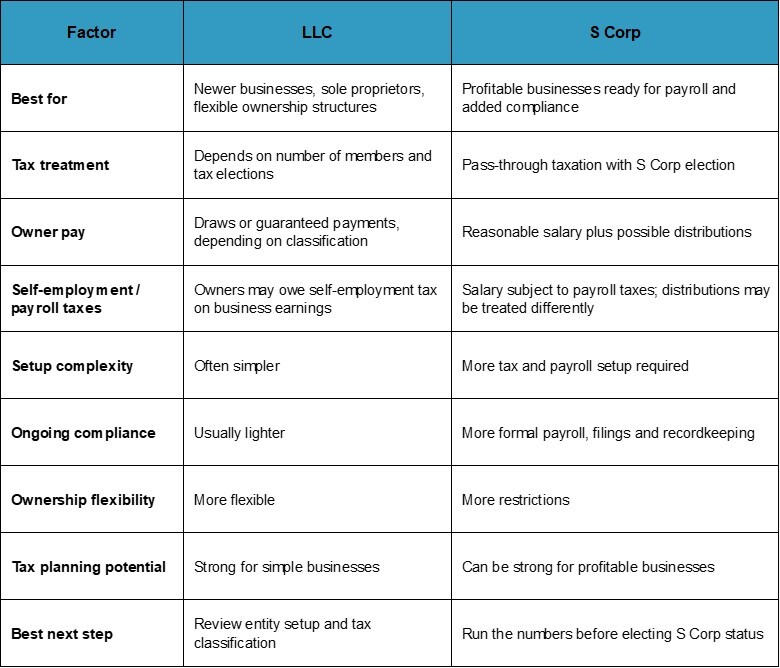
An LLC may be better if you want simplicity, flexibility and fewer administrative requirements. An S Corp may be better if your business is consistently profitable, you actively work in the business and the potential payroll tax savings outweigh the added costs.
Tax Implications of an LLC
Understanding the specific tax mechanisms of an LLC helps prevent surprises during tax season.
Most LLCs function as pass-through entities by default. For a single-member LLC, business activity is generally reported on the owner’s personal return. For a multi-member LLC, the business typically files a partnership return and passes each member’s share of income or loss through on a Schedule K-1.
LLC owners frequently owe self-employment tax on business income, depending on how the LLC is taxed. This is one of the biggest tax considerations for sole proprietors and single-member LLCs.
Because many LLC owners do not receive a traditional paycheck with tax withholding, they may also need to make estimated tax payments throughout the year. Strong recordkeeping is essential. Owners should track deductible expenses, separate business and personal accounts and keep clean books for year-end planning. Explore more strategies on how to reduce self-employment tax legally.
An LLC offers flexibility in tax classifications. It may be taxed as a disregarded entity, a partnership, a C corporation or an S corporation, depending on eligibility and filed elections. This flexibility is one reason many business owners begin with an LLC and revisit tax elections as the business grows.
Pro Tip: Proper recordkeeping is not just a compliance task. It is the foundation for effective small business tax planning.
Tax Implications of an S Corp
Electing S Corp status changes your tax obligations and introduces new operational requirements.
The most important requirement is reasonable compensation. S Corp owner-employees must be paid a reasonable salary for their work. That salary runs through payroll and is generally subject to payroll taxes.
After paying reasonable salaries and business expenses, remaining profits may be distributed to shareholders. This is where many business owners hear about potential S Corp tax savings. However, this strategy must be handled carefully. If an owner takes distributions without paying reasonable compensation, the IRS may reclassify some of those payments as wages and assess payroll taxes, penalties or interest.
Operating an S Corp introduces additional administrative duties, including:
-
Formal payroll setup
-
Annual W-2 filing
-
Filing a dedicated S Corp tax return, Form 1120-S
-
K-1 reporting for shareholders
Maintaining separate, accurate business books and payroll records
State-level rules can also affect the decision. Some states charge franchise taxes, minimum entity fees, S Corp taxes or other pass-through entity taxes. This means an S Corp election may look beneficial at the federal level, but less attractive after state taxes and fees are included.
If the business produces modest profit, has inconsistent income or the owner is not ready to run payroll, S Corp costs may outweigh the expected tax savings. For example, a business earning $35,000 in annual profit may not save enough to justify the cost of payroll services, extra tax preparation, state fees and additional administrative work.
When an LLC May Make Sense
An LLC often serves as a practical starting point for new and growing businesses.
An LLC may make sense if:
-
You are just starting your business.
-
You are a freelancer, consultant or sole proprietor looking for liability separation.
-
You want a simpler tax and compliance setup.
-
Your business profit is still modest or inconsistent.
-
You want flexible ownership or management options.
-
You do not want to run payroll yet.
-
You are still testing your business model.
For example, a consultant earning part-time income may choose a single-member LLC for simplicity. This can make sense while they build consistent revenue.
At this early stage, the administrative cost of S Corp taxation may not yet make financial sense.
When an S Corp May Make Sense
Once a business matures, an S Corp election can offer useful tax planning opportunities.
An S Corp election may make sense if:
-
Your business generates consistent profit beyond what you need for a reasonable salary.
-
You actively work in the business.
-
You are ready to run a compliant payroll system.
-
You want to separate your personal salary from the overall business profit.
-
Potential tax savings exceed payroll, filing, bookkeeping and advisory costs.
- You have a long-term growth plan supported by clean records.
A business owner earning steady net profit may find that S Corp taxation creates planning opportunities once they can pay themselves a reasonable salary and still have profit available for distributions.
How to Choose Between an LLC and an S Corp for Taxes
Deciding between an LLC and an S Corp requires a clear look at your finances, operations and growth plans.
1. Start with profit.
Ask yourself, is the business consistently profitable year over year? How much net income remains after expenses? Is your income predictable enough to support a recurring payroll schedule?
2. Consider how you pay yourself.
If you currently take owner draws, switching to an S Corp means moving to a more formal compensation structure. You will need to understand how salary, distribution, withholding and payroll taxes work together.
3. Compare potential tax savings against added costs.
These may include monthly payroll service fees, higher tax preparation costs, state fees, bookkeeping support and administrative time.
4. Think about where your business is going.
Will you add employees? Bringing on partners or outside investors? Expanding into other states? Need more formal financial reporting for lenders?
5. Run side-by-side tax projections.
Before making an S Corp election, compare how your tax picture may look under your current structure versus S Corp taxation. A tax advisor can help estimate reasonable compensation, payroll taxes, self-employment tax impact, state fees and filing costs.
Ask before you switch: Will the S Corp election actually reduce your taxes after payroll, compliance, state fees, bookkeeping and tax preparation costs are factored in?
Can You Switch From LLC to S Corp Taxation?
Yes. In many cases, an LLC can elect to be taxed as an S Corp if it meets IRS eligibility requirements.
At a high level, the process may involve:
-
Confirming the LLC remains eligible for S Corp taxation.
-
Filing the appropriate IRS election form, typically Form 2553.
-
Setting up compliant payroll for owner-employees.
-
Updating bookkeeping and accounting processes.
-
Planning how salary and distributions will be handled.
-
Reviewing state-level requirements and tax changes.
Business owners typically consider making the switch when their net profits have increased, revenue is stable and they want a more formal compensation strategy.
Why Timing Matters
S Corp elections have strict IRS deadlines. While a late election may be available in some cases, business owners shouldn’t rely on fixing the paperwork later.
If you are considering a switch, review deadlines before the new tax year or as soon as your business becomes consistently profitable.
Choosing the Right Structure Starts with the Right Tax Strategy
Choosing between an LLC and an S Corp for tax purposes is not about picking the “best” structure, in general. It is about choosing a framework that aligns your income, ownership model, compliance capacity and future plans.
For some business owners, an LLC offers the right balance of simplicity and flexibility. For others, S Corp taxation may create meaningful planning opportunities as the business scales.
Before forming a new entity, changing your tax election or adjusting how you pay yourself, make sure you understand the full tax impact.
FAQs
Is an S Corp better than an LLC for taxes?
Not always. An S Corp may create tax planning opportunities for profitable businesses, while an LLC may be better for overall simplicity and flexibility.
Can an LLC be taxed as an S Corp?
Yes. If eligible, an LLC can elect to be taxed as an S Corp while remaining an LLC under state law.
Is an LLC better for a new business?
Most of the time, yes. Many new business owners start with an LLC because it can be simpler and more flexible, especially before profits become consistent.
When should I switch from LLC to S Corp?
Business owners should consider switching from an LLC to an S Corp when profits are consistent enough that potential tax savings may exceed the added payroll, bookkeeping, compliance and filing costs.
Should I ask a CPA before choosing LLC or S Corp taxation?
Yes. A tax professional can compare estimated tax outcomes, payroll requirements, state rules and long-term business goals before you make a decision.
Talk to an LTax tax advisor before choosing or changing your business tax structure and find out which option is right for you.
LEGAL OR TAX: The information herein is not legal, such as trust or estate planning, advice, or tax advice. Any such information is provided for illustrative purposes only and must not be relied upon without the benefit of the advice of your lawyer and/or tax professional. Lido specifically disclaims any liability from any reliance on such information. Lido is not a legal service provider or tax professional and does not offer legal or tax advice. Should you desire to obtain tax or legal services or advice, you must enter into your own, independent engagement agreement with a licensed attorney or tax professional.