The U.S. tax system is a pay-as-you-go system. Rather than waiting until you file your annual return, most people must pay tax throughout the year as they earn income. For employees, your employer automatically withholds tax. For everyone else, estimated tax payments cover federal income tax and, for many self-employed individuals, self-employment tax.
This guide explains who must pay estimated taxes, payment deadlines, and how to estimate and submit payments. We’ll also cover strategies to reduce penalties and avoid mistakes.
What Are Estimated Taxes?
Estimated taxes are periodic payments made toward your expected annual federal tax liability when not enough tax is withheld automatically. The IRS requires taxes to be paid as income is earned or received during the year, through either withholding or estimated tax payments.
Most employees never think about this because their employer withholds tax from each paycheck. But income from freelance work, investments, rental properties, and business profits often carries no withholding. Estimated payments allow you to cover those obligations throughout the year. They may include federal income tax, self-employment tax, and certain other taxes such as the alternative minimum tax.
Important Note: Estimated taxes are not a separate or additional type of tax. They are a method of prepaying the tax that will ultimately be reported on your annual return.
Income that may require estimated payments includes:
-
Freelance and independent-contractor earnings
-
Sole proprietorship or single-member LLC profits
-
Partnership or S corporation pass-through income
-
Interest and dividends
-
Capital gains
-
Rental income
-
Royalties
-
Other taxable income without sufficient withholding
Who Needs to Pay Estimated Taxes?
The federal rule for individuals is fairly straightforward. You will typically need to make estimated payments when both of the following apply:
1. You expect to owe at least $1,000 in federal tax after subtracting withholding and refundable credits.
2. You expect your withholding and refundable credits to be less than the smaller of 90% of the tax owed for the current year, or 100% of the tax shown on your prior-year return.
That prior-year percentage generally increases to 110% when prior-year adjusted gross income exceeds $150,000, or $75,000 for married taxpayers filing separately.
These thresholds are a “safe harbor,” a benchmark to help you avoid paying penalties. We’ll explain “safe harbor” in more detail shortly.
Freelancers and Independent Contractors
Businesses typically do not withhold taxes for independent contractors. As a result, estimated payments will need to cover both federal income and self-employment tax, which fund Social Security and Medicare.
A common misconception is that a Form 1099 triggers the tax obligation. It does not. Taxable freelance income must generally be reported even when no 1099 is issued. The responsibility to pay rests on you, regardless of the paperwork you receive.
Small Business Owners
Estimated payments may be needed when you receive capital gains, dividends, interest, rental income, cryptocurrency gains, or other investment income.
This catches many people off guard. A one-time stock sale or other large gain can trigger estimated taxes, even if you mainly earn W-2 wages. If you sell an appreciated asset and your paycheck withholding won’t cover the tax, you may need to make a payment to match your taxable income.
Estimated Tax Safe Harbor Rule Explained
A safe harbor is an amount you pay during the year to avoid an underpayment penalty, even if your final tax bill is higher than expected.
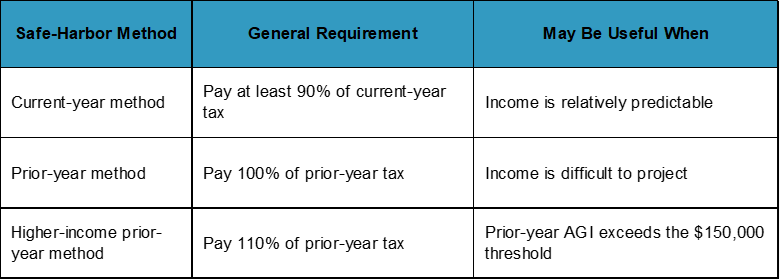
Meeting a safe harbor helps you avoid an underpayment penalty, but it does not erase any remaining balance. If your actual tax is higher, you’ll still owe the difference when you file.
Who When Are Estimated Tax Payments Due?
Federal estimated taxes are usually paid in four installments. While called “quarterly taxes,” the IRS payment periods are not four equal quarters. The second period is shorter than the others.
Save the Dates: 2026 Estimated Tax Due Dates
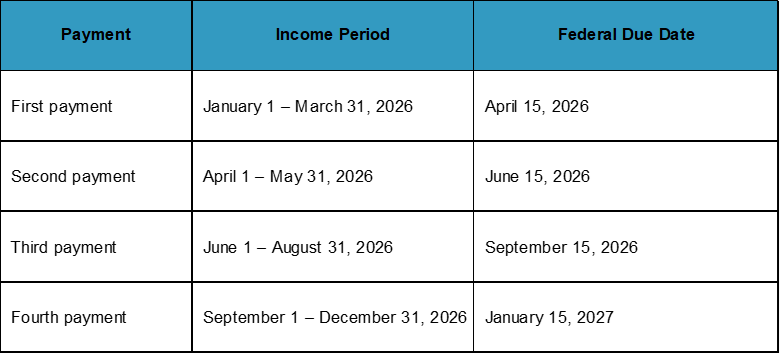
Two important notes:
1. If a due date falls on a weekend or federal holiday, payment is due the next business day.
2. State estimated tax deadlines often overlap but may vary. Check with your state’s Department of Revenue.
How to Calculate Estimated Tax Payments
The IRS provides Form 1040-ES, with a worksheet to estimate your annual income, deductions, credits, and tax liability. Start with your prior-year return as a guide, then adjust for expected changes in:
-
Business or freelance income
-
Investment gains and losses
-
Deductible business expenses
-
Retirement contributions
-
Filing status or number of dependents
-
Tax credits
-
Other household income
-
Withholding from wages or pensions
Method 1: Prior -Year Estimate
This is the simplest option and guarantees you won’t owe an underpayment penalty regardless of your current-year income. It works well for those with at least two years of earnings without withholding and whose income is fairly consistent from year to year.
1. Take your total tax liability from the previous year.
2. If your prior-year income was $150,000 or less, multiply that by 100%.
3. Divide by four for your quarterly payment.
4. If your prior-year income exceeds $150,000, multiply by 110%.
5. Divide by four for each quarterly payment.
For example, if you owed $24,000 in taxes last year, you’d make four equal payments of $6,000 each quarter. If you’re a higher earner and make over $150,000, you’d add 10% to each quarterly payment. That would mean your quarterly payment would be $6,600.
Method 2: Annualized Income Estimate
When your income fluctuates or is delayed, the annualized income installment method may help. This method better aligns your payments more closely with your actual earnings. You estimate each quarter’s tax owed based on your quarterly income minus any deductions.
Business write-offs reduce your net profit, lowering both your estimated income tax and self-employment tax. Track your deductible business expenses throughout the year to lower what you owe.
This annualized approach is best for:
-
A seasonal business
-
A freelancer whose income fluctuates regularly
-
An investor who realizes a large gain during one part of the year
-
A real estate owner who sells a property late in the year
How and Where to Pay Estimated Taxes
The IRS offers several payment methods. Electronic options are generally the easiest and most reliable.
IRS Online Account or Direct Pay. You can make federal estimated payments electronically from a bank account. These services also keep track of payment verifications.
Electronic Federal Tax Payment System (EFTPS). EFTPS lets you schedule payments in advance, review your payment history, and change or cancel scheduled payments. Register before deadlines, as enrollment takes time.
Debit card, credit card, or digital wallet. These options are available through third-party processors, though processing fees may apply.
Check or money order. You can mail a payment with the appropriate Form 1040-ES voucher. Verify the mailing address before sending and keep proof of timely payment.
State estimated tax payments. Federal payments do not cover state or local income taxes. You may need to make a separate payment through your state’s department of revenue, taxation agency, or equivalent authority.
What Happens If You Miss or Underpay an Estimated Tax Payment?
The IRS may charge an underpayment penalty when you pay less than the required amount, make a payment after its deadline, or pay enough for the year overall but not enough during an earlier payment period. That last scenario surprises many taxpayers. You can be penalized for timing, even when your total payments are met.
The penalty is based on the amount underpaid, how long the amount remained unpaid, and the applicable IRS interest rate. It’s also worth remembering that filing an extension extends your time to file, not your time to pay.
If you’ve missed an estimated payment, take these steps:
-
Make the payment as soon as possible to limit the penalty and interest charge.
-
Recalculate any remaining estimated payments.
-
Check if withholding additional wages could help cover the shortfall.
-
Keep records of your payment confirmations.
-
Consult a tax professional when you’ve missed multiple deadlines.
Penalty exceptions or waivers may apply in limited circumstances, such as a casualty or disaster, or for certain taxpayers who recently retired or became disabled.
Common Estimated Tax Mistakes
Watch for these common errors that continue to cost taxpayers:
1. Calculating payments from gross revenue. Self-employed taxpayers are generally taxed on net business profit after eligible expenses, not on total customer payments.
2. Forgetting self-employment tax. Freelancers often estimate income tax but overlook the Social Security and Medicare taxes included in their overall obligation.
3. Assuming the payment periods are equal calendar quarters. The second payment period is shorter than the others, so put all four deadlines on your calendar.
4. Using last year’s numbers without updating them. Income, deductions, credits, filing status, and tax laws can all change from one year to the next.
5. Ignoring investment income or one-time gains. Even a W-2 employee may need to adjust payments after selling stock, property, or another appreciated asset.
6. Forgetting state and local estimated taxes. Federal and state payments are entirely separate obligations. Check with your state and local tax authorities to stay on track.
7. Waiting until tax season to review payments. Quarterly or mid-year check-ins let you adjust before an unexpected balance grows.
Make Estimated Taxes Part of Your Year-Round Plan
Estimated taxes don’t have to be a recurring source of stress. Start by determining whether you meet the estimated-payment threshold, add the four federal deadlines to your calendar, and calculate each payment using current income and deductions. Revisit these numbers whenever your income or financial situation changes.
For help calculating your estimated payments or creating a complete individual or small business tax strategy, contact an LTax team member to build a plan around your income, goals, and tax obligations.
FAQ
Do freelancers have to pay quarterly estimated taxes?
Freelancers may need to make estimated payments when their income is not subject to withholding, and they expect to owe at least $1,000 in federal tax after subtracting withholding and refundable credits.
How much should I set aside for estimated taxes?
The right amount depends on your net self-employment income, other household income, deductions, credits, filing status, and state taxes. A percentage-based savings rule can help with cash flow, but Form 1040-ES or a customized tax projection gives you a more accurate estimate.
Are estimated taxes always divided into four equal payments?
Not necessarily. Taxpayers with a steady income often make four equal installments. Those with uneven or seasonal income may use the annualized income installment method to align payments more closely with when income was earned.
Can I pay estimated taxes monthly instead of quarterly?
Yes. You may make payments more frequently, as long as you’ve paid the required amount by each applicable federal deadline.
Can I avoid estimated payments by increasing paycheck withholding?
Possibly, if you or your spouse earns W-2 income. You may be able to request additional withholding by submitting an updated Form W-4. This can sometimes cover the tax due on freelance, investment, or business income.
Are estimated tax payments deductible?
No. Federal estimated income tax payments are prepayments of personal tax liability, not deductible business expenses.
What happens if I overpay estimated taxes?
An overpayment is generally applied when you file your annual return. Depending on the return, you may receive a refund or choose to apply the overpayment toward the following year’s estimated taxes.
LEGAL OR TAX: The information herein is not legal, such as trust or estate planning, advice, or tax advice. Any such information is provided for illustrative purposes only and must not be relied upon without the benefit of the advice of your lawyer and/or tax professional. Lido specifically disclaims any liability from any reliance on such information. Lido is not a legal service provider or tax professional and does not offer legal or tax advice. Should you desire to obtain tax or legal services or advice, you must enter into your own, independent engagement agreement with a licensed attorney or tax professional.