

The tax-advantaged investing landscape is shifting. For nearly a decade, Qualified Opportunity Zones (QOZs) have provided a compelling way to defer capital gains and drive economic growth. But with the original program (QOZ 1.0) sunsetting at the end of 2026 and the new “QOZ 2.0” framework taking effect for investments made on or after January 1, 2027, investors are entering a key transition period.
This guide breaks down tax changes under the One Big Beautiful Bill Act (OBBBA), the timeline for the 2026–2027 transition, and the questions you need to ask your tax advisor before committing capital.
Opportunity Zones 101: A Quick Refresher
What Are Opportunity Zones?
Established under the Tax Cuts and Jobs Act, Opportunity Zones were created to spur economic development and job creation in designated low-income communities across all 50 states, the District of Columbia, and U.S. territories.
The program’s core investment vehicle is the Qualified Opportunity Fund (QOF). These investment entities were created to allocate capital to eligible Qualified Opportunity Zone Businesses (QOZB) and Qualified Opportunity Zone Business Properties (QOZBP), real estate, located within designated Opportunity Zones. These investments are funded with capital gains, allowing taxpayers to defer tax that would otherwise be due.
While successful in allocating capital, the 2017 program encountered criticism regarding its impact and geographic distribution. QOZ 2.0 was designed to tackle these concerns and create more targeted incentives.
The 2026 Sunset: What Happens to QOZ 1.0 Deferred Gains?
The most urgent shift for current investors is timing. QOZ 1.0 and QOZ 2.0 differ not only in policy but also in when key rules apply.
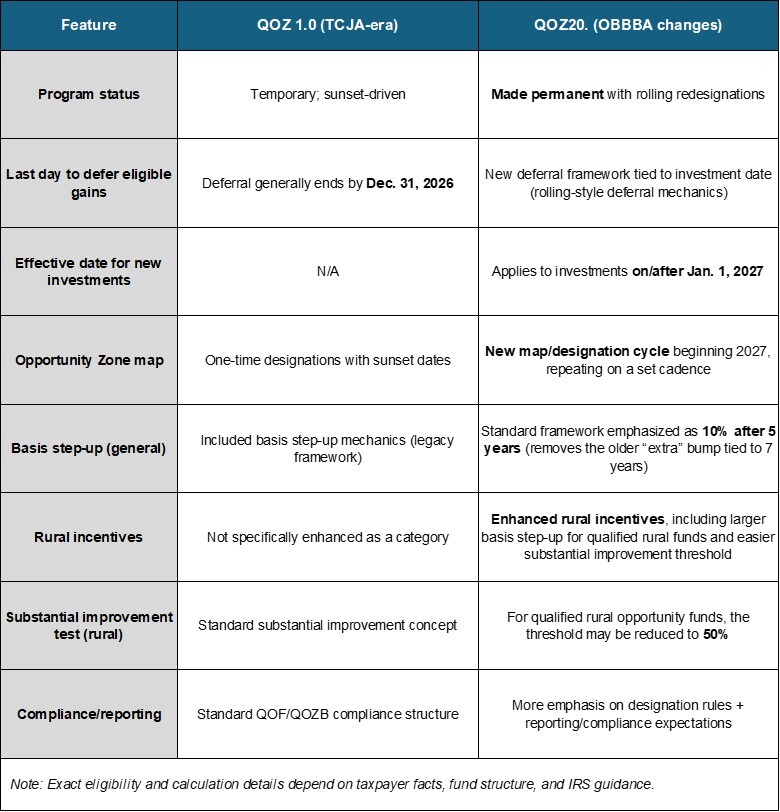
1. QOZ 1.0 deferred gains generally come due at year-end 2026
For investors in the initial program, the deferral clock is ticking. Deferred gains are to be recognized at the earlier of an inclusion event (such as the sale of a QOZ interest) or December 31, 2026. This means the tax liability related to those gains will typically be reported on the 2026 tax return, filed in 2027.
2. QOZ 2.0 applies to investments made on/after January 1, 2027
The new rules under QOZ 2.0 apply to investments made on or after January 1, 2027. This creates a clear division: investments made before this date largely follow legacy rules, while investments made after fall under the redesigned, permanent framework.
Introducing OZ 2.0: Key Changes & Features
Program Made Permanent & Rolling Designations
QOZ 2.0 is now a permanent fixture of the tax code. Instead of a one-time map that expires, the program will now feature rolling designation cycles, allowing Opportunity Zones to be updated every 10 years to better reflect changing economic conditions.
New Opportunity Zone Maps Beginning in 2027
Starting July 1, 2026, state governors will select new Opportunity Zones every 10 years, with designations taking effect January 1, 2027.
The original QOZ map and the new QOZ 2.0 map will both be in effect from January 1, 2026, through December 31, 2028. This period allows time for existing investments to mature, though some tracts may lose designation after 2028.
Updated Tax Benefits and Incentives
For capital gains invested in a QOF on or after January 1, 2027, the structure changes:
-
5-Year Deferral: Gains are deferred for 5 years from the date of investment (not tied to a fixed calendar deadline).
-
10% Basis Step-Up at 5 Years: Investors receive a 10% step-up in basis on the initial deferred gain after holding for 5 years.
-
10-Year Exclusion: The same as the program, holding for 10 years allows investors to exclude appreciation on the investment from taxable income.
30-Year Cap: Any gains recognized beyond 30 years become taxable.
While QOZ 1.0 offers a 15% step-up for 7-year holds, QOZ 2.0 now offers a single 5-year threshold for a 10% step-up. The trade-off is a lower maximum basis reduction, but the rolling deferral period offers greater flexibility for future planning.
Stricter Designation Rules & Expanded Compliance Focus
QOZ 2.0 also introduces stricter compliance and reporting requirements. Failure to meet requirements, such as the 90% asset test, substantial improvement thresholds, or business activity rules, can result in disqualification and immediate recognition of deferred gains.
Investors and funds will need to familiarize themselves with reporting requirements for Forms 8996 (QOF annual certification) and 8997 (investor reporting). In addition, new schedules for the QROF designation and rural property certification are forthcoming.
Pro Tip: Keep detailed records of QOZ property location, acquisition dates, improvement costs, and substantial improvement tracking to meet reporting requirements.
QOZ 1.0 vs QOZ 2.0 Comparison Chart
Qualified Rural Opportunity Funds: What Investors Should Know
What Are QROFs?
Qualified Rural Opportunity Funds (QROFs) are QOFs that hold at least 90% of their assets in Qualified Opportunity Zone Property located in rural areas. Under the OBBBA, a rural area is generally defined as any area outside a city or town with a population greater than 50,000.
Enhanced Tax Benefits for Rural Investment
Investors in QROFs receive two additional benefits:
1. Larger Basis Step-Up: After a 5-year hold, investors receive a 30% step-up in basis on the deferred gain (compared to 10% for a standard QOF).
2. Reduced Substantial Improvement Threshold: Property in a rural QOZ must achieve only a 50% improvement in basis (rather than the standard 100%) to be deemed "substantially improved."
These incentives aim to move capital into rural communities facing barriers to investment. In practice, they also enable fund managers to structure dedicated rural offerings to attract investors looking for maximum basis reduction and lower improvement hurdles.
The Late-2026 Bridge Strategy
If you realize a capital gain in late 2026, you may be able to take advantage of the new Qualified Opportunity Zone (QOZ) 2.0 benefits by timing your investment into a Qualified Opportunity Fund (QOF) for early 2027. The key is that the 180-day window to reinvest your gain may extend into the new year. As long as your QOF investment is made on or after January 1, 2027, you can access QOZ 2.0 features, including a rolling five-year deferral, a 10% basis step-up after five years, and continued exclusion of post-investment appreciation after 10 years.
This “late-2026 bridge strategy” allows you to capitalize on the enhanced incentives, but it requires careful planning and close attention to IRS guidance as implementation details are finalized.
Example:
-
Gain Realized: November 15, 2026
-
180-Day Deadline: May 14, 2027
-
QOF Investment Date: January 2, 2027
-
Result: The investment qualifies for QOZ 2.0 benefits, including the rolling five-year deferral and enhanced basis step-up, because the investment was made after December 31, 2026, even though the gain was realized in 2026.
The IRS and Treasury are expected to issue transition guidance to clarify the mechanics of this bridge period, but the statutory language supports the strategy. LTax will continue to monitor IRS guidance for any additional requirements or clarifications as the new rules are implemented.
State & Local Tax Treatment
It’s also important to remember that federal tax breaks do not always apply at the state level. Some states will immediately conform to federal QOZ 2.0 rules, meaning you’ll get state tax breaks, too. Others will only partially conform, while others will “decouple” entirely. Partial and “decoupling” means you may owe state taxes on capital gains immediately, even if federal tax is deferred. Always check the state impact on tax planning before investing.
Position Yourself for QOZ 2.0 Success
The One Big Beautiful Bill Act turns the Qualified Opportunity Zone program into a permanent fixture of the tax code. With stricter eligibility rules but enhanced rural incentives, QOZ 2.0 offers new opportunities for tax-efficient investing.
However, the transition can be complex. With QOZ 1.0 deferred gains due at year-end 2026 and QOZ 2.0 starting in 2027, you have a narrow window to optimize your strategy. Whether you’re looking to defer gains, invest in rural development, or navigate the late-2026 bridge strategy, careful planning is essential.
Consult an LTax team member toevaluate whether QOZ 2.0 investing fits with your financial goals. We’ll help you review timing requirements, identify qualified funds, and implement a tax strategy designed to increase your after-tax returns while monitoring risk and compliance
LEGAL OR TAX: The information herein is not legal, such as trust or estate planning, advice, or tax advice. Any such information is provided for illustrative purposes only and must not be relied upon without the benefit of the advice of your lawyer and/or tax professional. Lido specifically disclaims any liability from any reliance on such information. Lido is not a legal service provider or tax professional and does not offer legal or tax advice. Should you desire to obtain tax or legal services or advice, you must enter into your own, independent engagement agreement with a licensed attorney or tax professional.